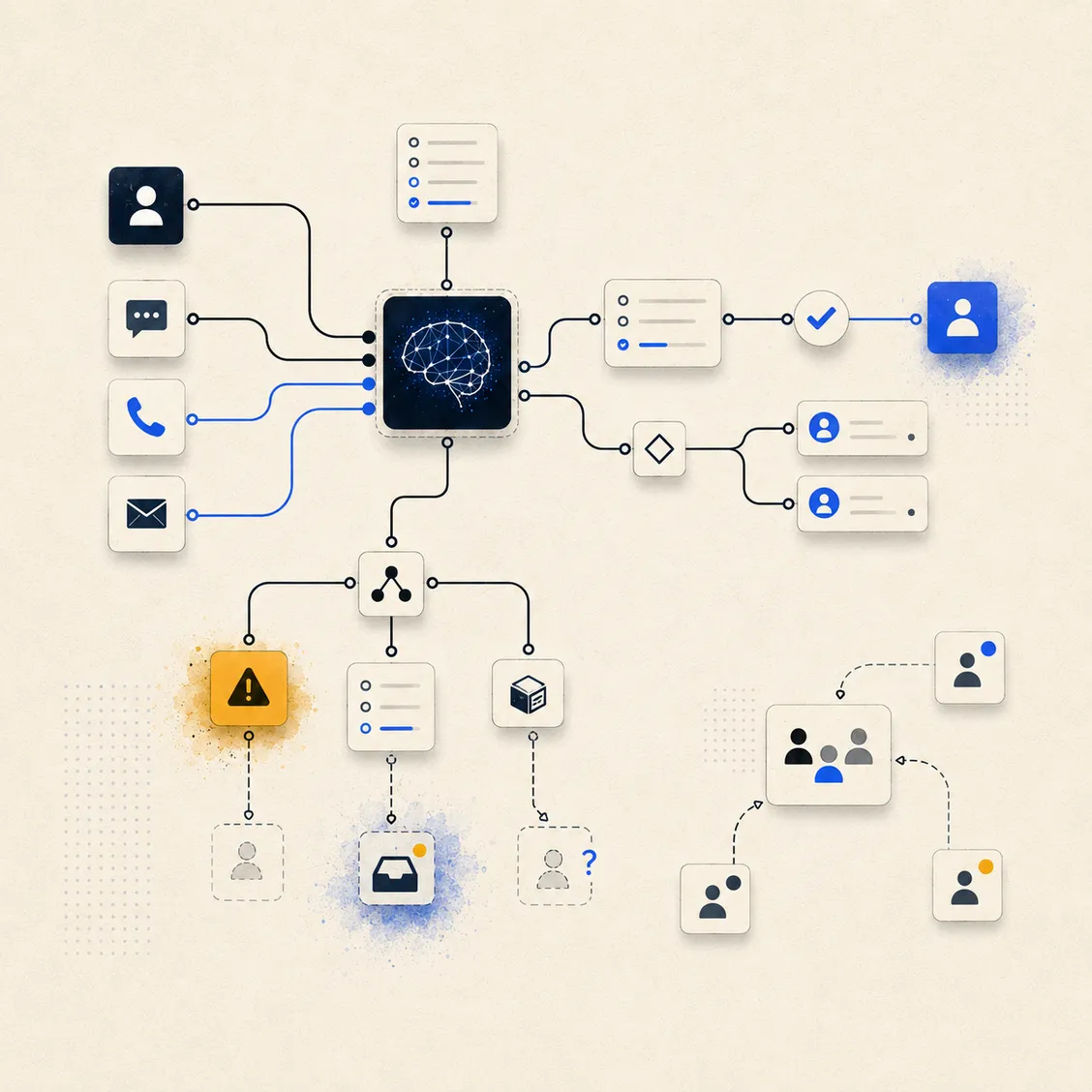

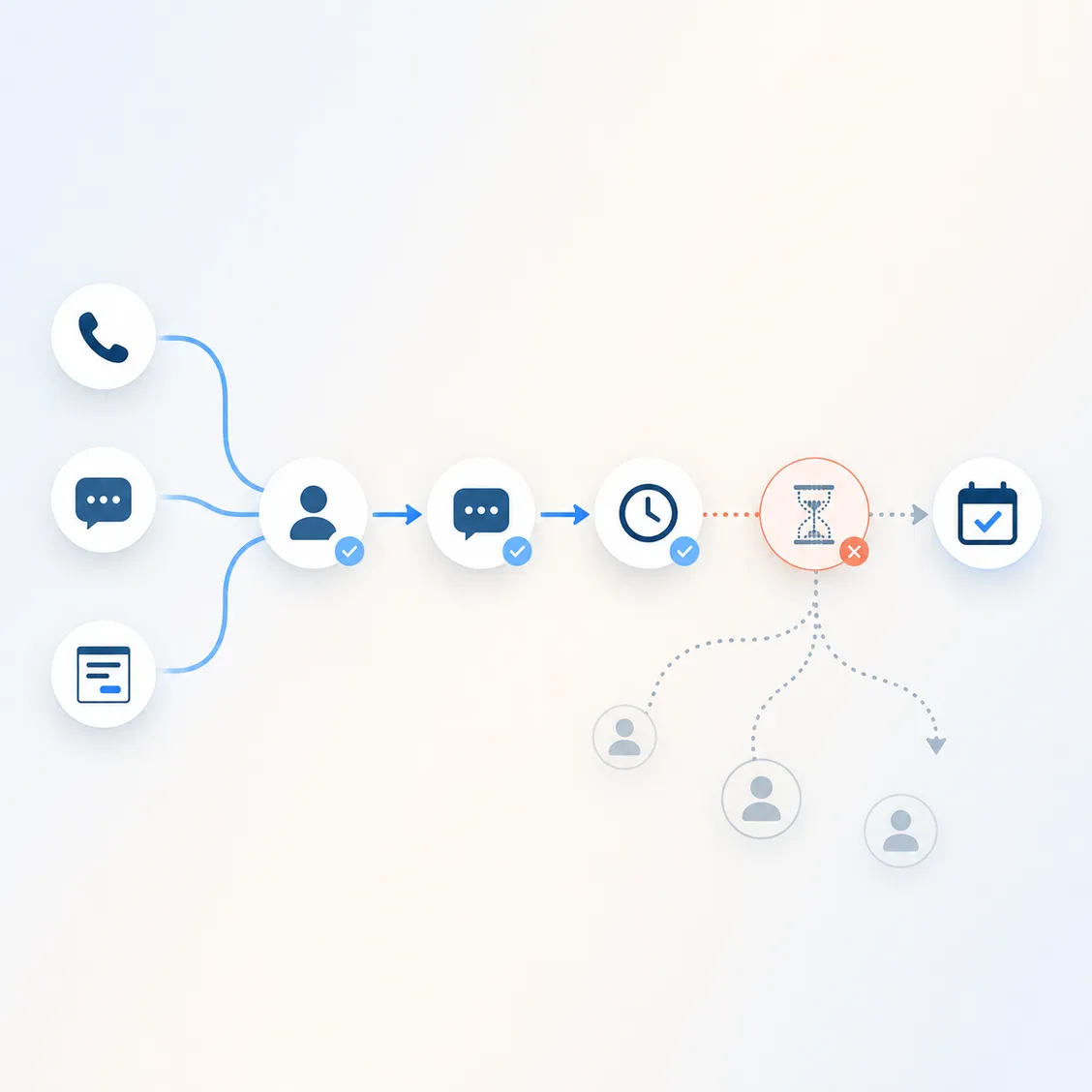
Why more traffic will not fix slow replies, forgotten follow-up, or a pipeline full of buyers nobody called back.
Most businesses think they have a lead generation problem.
They want more traffic.
More ads.
More form fills.
More calls.
More names entering the CRM.
But many of them do not actually need more leads.
They need to stop wasting the ones already arriving.
A prospect calls and nobody answers.
A form comes in and sits untouched.
Someone asks for pricing, receives a vague reply, and never hears from the business again.
A quote is sent, then forgotten.
A lead is marked “follow up” with no date, no owner, and no next step.
The pipeline looks full.
The revenue does not follow.
That is not a traffic problem.
It is a follow-up problem.
More traffic can hide the real leak
When lead volume feels low, increasing traffic seems like the obvious solution.
Spend more on ads.
Push harder on SEO.
Post more content.
Launch another campaign.
Sometimes that is exactly what the business needs.
But if the response and follow-up process is already weak, adding more traffic only sends more opportunities into the same broken system.
The business may celebrate a higher number of inquiries while losing a similar percentage of them after first contact.
More volume creates more activity.
It does not automatically create more customers.
A leaking bucket does not become more efficient because more water is poured into it.
The most expensive leads are often already in the pipeline
Generating a lead takes effort.
The business may have paid for the click.
A staff member may have earned the referral.
A marketer may have spent weeks creating the campaign.
The prospect may have read reviews, compared options, visited the website several times, and finally decided to reach out.
Then the lead enters the system.
This is the moment when interest should be protected.
Instead, the inquiry often becomes just another line in a spreadsheet or record in a CRM.
It waits.
It gets assigned late.
It receives one generic reply.
It is forgotten after the first unanswered call.
The hardest part—getting someone to raise their hand—has already happened.
The business loses the opportunity during the supposedly easier part.
Slow replies reduce intent
Interest is not permanent.
A prospect who reaches out today may feel differently tomorrow.
Not because the service suddenly became irrelevant.
Because the urgency changed.
They found another provider.
They became distracted.
They decided the process looked difficult.
They forgot why they contacted the business in the first place.
Or someone else simply made the next step easier.
This is especially true in high-intent service categories.
A person looking for a dentist, lawyer, clinic, contractor, consultant, or specialist usually wants movement.
They want an answer.
They want to know whether the business can help.
They want to understand the next step.
The longer the silence lasts, the more likely the prospect is to keep searching.
Response speed matters because it protects momentum.
But fast response is only the beginning.
One reply is not follow-up
Many teams believe they are following up because they contact the lead once.
They send an email.
They leave a voicemail.
They reply to the form submission.
Then they wait.
If the prospect does not respond, the lead is treated as cold.
But one attempt does not tell the business much.
The message may have arrived at a bad time.
The prospect may have missed the call.
They may have needed to check their schedule.
They may have opened the email and intended to reply later.
They may have wanted a clearer answer before committing.
Silence after one message is not a reliable sign of disinterest.
It is simply a sign that the conversation did not move forward yet.
Good follow-up continues until there is a clear outcome.
That outcome could be:
- A booking
- A qualified next step
- A request to reconnect later
- A clear rejection
- A disqualification
- A human handoff
What matters is that the lead does not disappear without an answer.
Follow-up fails when ownership is vague
A CRM can contain hundreds of leads and still provide no clarity.
Who owns this contact?
Who is expected to call?
When should they call?
What happened last time?
What is the next step?
What happens if the owner is unavailable?
If the system cannot answer those questions, the pipeline is not organized.
It is storage.
Vague ownership creates predictable problems.
Two people assume the other person will respond.
Nobody notices the lead is aging.
A task is created but buried.
A conversation happens outside the CRM.
The next employee opens the record and has no context.
The prospect receives duplicate messages—or none at all.
A lead should never rely on collective memory.
Each inquiry needs one clear owner, one visible status, and one defined next action.
A full pipeline can be a false comfort
A growing pipeline looks healthy.
It suggests momentum.
It gives the team something to report.
But volume inside the CRM can be misleading.
Some leads may have received no reply.
Some may be waiting for a promised follow-up.
Some may have gone quiet after asking a question.
Some may already have chosen another provider.
Some may still be highly interested but forgotten.
A pipeline should not only show how many leads exist.
It should show how many are moving.
Useful questions include:
- How many new inquiries have no owner?
- How many have not received a response?
- How long does the first response take?
- How many have no next task?
- How many have been inactive for several days?
- How many requested information but never received it?
- How many appointments were missed without follow-up?
- How many quotes were sent without another touch?
A pipeline full of unresolved leads is not necessarily an asset.
It may be a record of missed opportunities.
Weak follow-up makes good marketing look bad
Poor follow-up often gets blamed on lead quality.
The team says the leads were not serious.
Marketing says the sales process is weak.
Sales says the inquiries were unqualified.
The owner concludes the campaign did not work.
Sometimes the leads genuinely are poor.
But that conclusion should not be reached before the follow-up process is examined.
A lead that receives a slow response may appear less interested.
A prospect who is asked the same questions twice may stop replying.
A person who never receives the promised information may seem unqualified.
A missed caller who gets no callback disappears before anyone learns what they needed.
Marketing performance cannot be judged fairly when the lead journey after capture is inconsistent.
The campaign may have created interest.
The operation failed to convert it.
Good follow-up reduces the effort to continue
Weak follow-up asks the prospect to restart the conversation.
Just checking in.
Let me know if you are still interested.
Following up on my last email.
These messages create work for the recipient.
They need to remember the context, decide what to say, and figure out the next step.
Better follow-up makes the response easier.
You asked about availability this week. We have Tuesday at 3:00 or Thursday at 11:30. Would either work?
Still looking for help with this? I can answer the main question here or send the booking link.
No problem if the timing changed. Should we close this for now or check back next month?
The goal is not to pressure the prospect.
It is to remove uncertainty.
Each message should help the conversation progress.
Follow-up should change with the situation
A strong process does not send the same reminder repeatedly.
It reacts to what has already happened.
A new inquiry may need an immediate acknowledgment.
A missed call may need a quick text.
A prospect who requested pricing may need a direct answer.
Someone who opened a booking link but did not schedule may need available times.
A no-show may need a rescheduling option.
A dormant lead may need a different reason to re-engage.
The system should know the difference.
That requires context.
Where did the lead come from?
What did they ask?
What was sent?
Did they reply?
Did they book?
Did a human already take over?
Without context, automation becomes repetitive.
With context, it becomes useful.
Automation should support the follow-up process, not replace judgment
Automation is well suited to consistency.
It can make sure every inquiry receives an acknowledgment.
It can schedule the next touch.
It can stop a sequence after a reply.
It can update the CRM.
It can remind a team member to act.
It can revive older leads.
It can flag high-value or sensitive conversations for review.
But not every situation should be handled automatically.
Some questions require judgment.
Some prospects need reassurance.
Some opportunities are too important for a generic sequence.
Some conversations become emotional, complex, or sensitive.
A good system does not force automation into every moment.
It handles the predictable parts and brings humans in when the conversation needs them.
Stop rules are part of good follow-up
More follow-up is not always better.
A system should stop when:
- The prospect books
- The prospect replies
- The lead asks not to be contacted
- A human takes ownership
- The inquiry is disqualified
- The sequence reaches its agreed limit
Without stop rules, follow-up creates friction.
A person books and continues receiving reminders.
A customer replies but receives another automated message.
A staff member begins a real conversation while the system keeps sending generic follow-ups.
This makes the business look careless.
The goal is not to contact people endlessly.
The goal is to keep unresolved opportunities from being forgotten.
Fix follow-up before buying more traffic
Before increasing ad spend, inspect the journey that follows every inquiry.
Look at:
- First-response time
- Missed-call recovery
- Lead assignment
- Number of follow-up attempts
- Average time between attempts
- Unanswered quotes
- No-show recovery
- Unowned leads
- Records with no next step
- Opportunities inactive for too long
Then ask:
Where do interested people stop moving?
That point is usually more valuable than another traffic campaign.
Because a small improvement in response and follow-up can increase the value of every channel already producing inquiries.
Paid ads perform better.
Referrals convert more consistently.
Website traffic becomes more valuable.
The sales team spends less time searching for context.
The CRM becomes a working system instead of an archive.
The takeaway
More traffic does not repair poor follow-up.
It gives poor follow-up more opportunities to fail.
Before paying to create more demand, make sure the business can protect the interest it already generates.
Reply quickly.
Assign ownership.
Define the next step.
Follow up until the conversation reaches a clear outcome.
Measure movement, not just pipeline volume.
The next customer may already be in the CRM.
They may simply be waiting for someone to call them back.