
Why leads disappear between the phone, calendar, CRM, and the person expected to act.
A new lead calls your business.
Someone answers, gathers a few details, and promises that the right person will follow up.
The conversation sounds successful. The caller feels heard. The team believes the inquiry has been handled.
Then nothing happens.
The notes remain beside the phone. The CRM record is incomplete. The calendar has no appointment. The person expected to follow up assumes somebody else already did.
The lead did not disappear because nobody cared.
It disappeared during the handoff.
Capturing a lead is not the same as handling one
Most businesses have several ways for people to get in touch:
- Phone calls
- Contact forms
- Website chat
- Text messages
- Social media
- Booking pages
- Referrals
The inquiry is usually captured somewhere.
That creates the impression that the lead is safely inside the business.
But a name and phone number sitting in an inbox is not a managed opportunity.
For the lead to move forward, several things still need to happen:
Someone needs to understand what the person wants. The right team member needs to receive the information. A next step needs to be offered. The calendar, CRM, and internal tasks need to reflect what happened. Follow-up needs to begin if the person does not book or reply.
The lead is only safe when ownership and the next action are clear.
Every transfer creates a place to lose momentum
A typical lead journey may look simple from the outside:
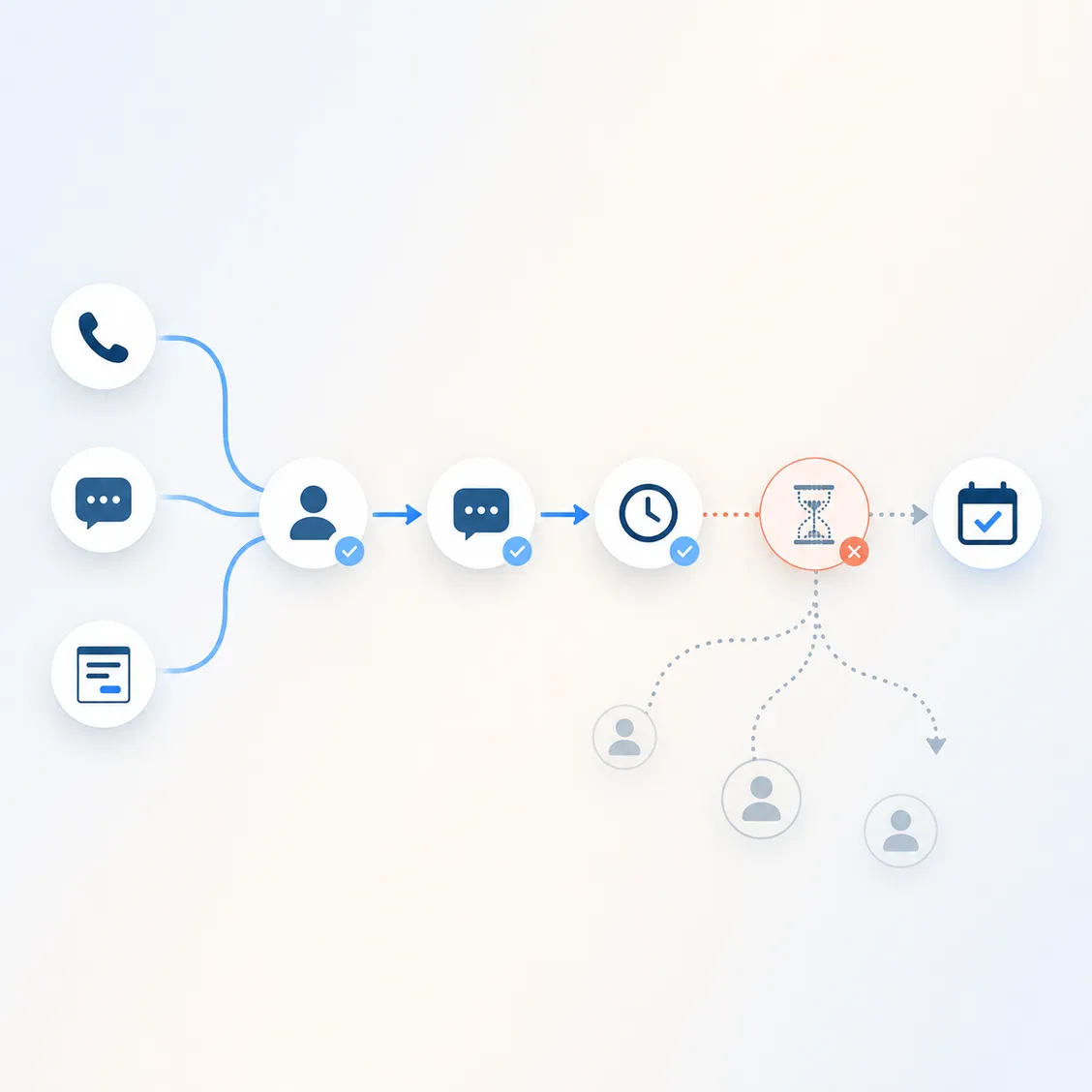
Inquiry → conversation → appointment → customer
Inside the business, it is often much more complicated:
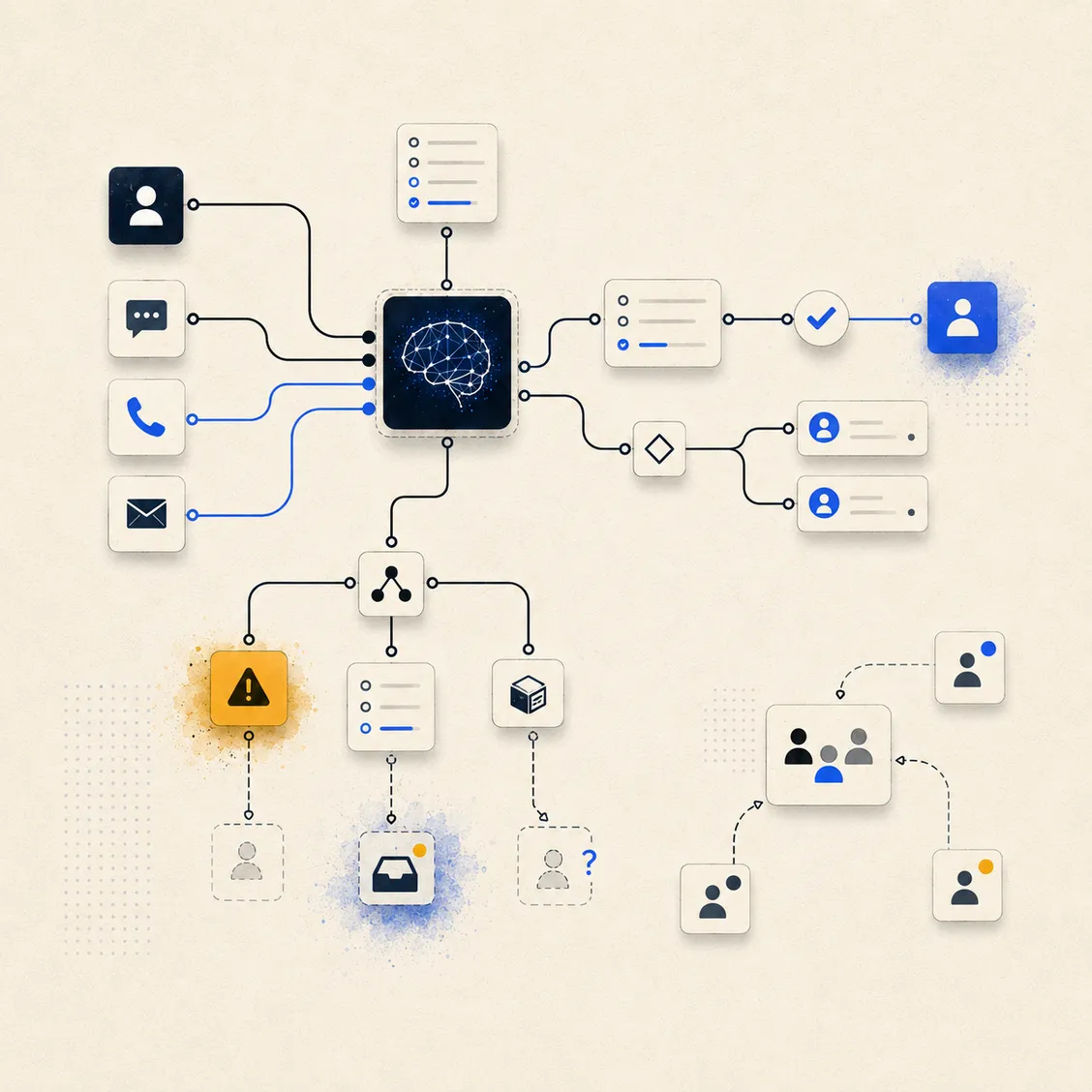
Phone call → receptionist → handwritten note → manager → CRM → sales representative → calendar → reminder → follow-up
Every arrow is a handoff.
And every handoff creates questions:
Who owns the lead now?
What exactly was promised?
How urgent is it?
What information is missing?
When should the next action happen?
What happens if that person is unavailable?
When those questions do not have automatic or clearly documented answers, the lead begins depending on memory.
That is when the risk increases.
The phone knows something the CRM does not
A prospect may explain everything during the first call.
They describe their situation, preferred timing, budget, location, urgency, or the specific service they need.
The person answering understands the conversation.
But when the call ends, only a small part of that context reaches the CRM.
The record may contain a name and number, but not:
- Why the person called
- Which service they need
- How urgent the request is
- What questions were already answered
- What the team promised to do next
- When the prospect expects to hear back
The next person then begins the conversation again.
The prospect has to repeat themselves.
Confidence drops because the business feels disconnected.
The problem is not necessarily poor customer service. It is that the information did not survive the handoff.
The calendar can hide an unfinished process
A booked appointment looks like a successful outcome.
But even then, the workflow may still be incomplete.
The appointment may be placed on the calendar without proper qualification.
The person responsible for the meeting may not receive the intake notes.
The prospect may not receive a clear confirmation.
No reminder may be scheduled.
If the person cancels or fails to attend, no recovery sequence may begin.
The calendar shows that something was booked, but it does not guarantee that the opportunity is being managed properly.
A calendar event is one step in the process.
It is not the entire process.
The CRM should create action, not just store data
Many businesses use a CRM as a digital filing cabinet.
Contacts are saved. Notes are added. Pipeline stages exist.
But the CRM does not actively drive what happens next.
A useful CRM workflow should answer practical questions:
- Who owns this lead?
- What stage are they in?
- What needs to happen next?
- When should it happen?
- What should occur if nobody acts?
- When should management be alerted?
A new lead should not simply appear in a database.
It should trigger movement.
That might mean assigning an owner, creating a task, sending a confirmation, scheduling follow-up, notifying the team, or escalating the inquiry based on urgency.
The CRM becomes valuable when it helps the business act—not merely remember.
Ownership must be specific
One of the most dangerous phrases in operations is:
Someone will follow up.
“Someone” is not an owner.
A lead needs a named person, team, or automated process responsible for the next action.
Ownership should transfer intentionally.
For example:
- The receptionist owns the initial intake.
- The system owns confirmation and reminders.
- The salesperson owns qualification.
- The practitioner or attorney owns the consultation.
- The follow-up workflow owns unanswered messages.
- A manager owns exceptions and high-value opportunities.
At every stage, the system should be able to answer:
Who is responsible now?
Without that clarity, multiple people may assume another person is handling it—or several people may contact the same lead with conflicting information.
Automation should connect the gaps
The most useful automation often sits between tools.
It makes sure that an action in one place creates the necessary action somewhere else.
For example:
A phone call ends, and the summary is added to the CRM.
A qualified lead is identified, and booking options are sent.
An appointment is scheduled, and the correct person is notified.
A meeting is missed, and a recovery message is triggered.
A lead reaches a high-value stage, and a manager receives an alert.
The goal is not to automate every conversation.
The goal is to stop important information and actions from getting trapped inside separate systems.
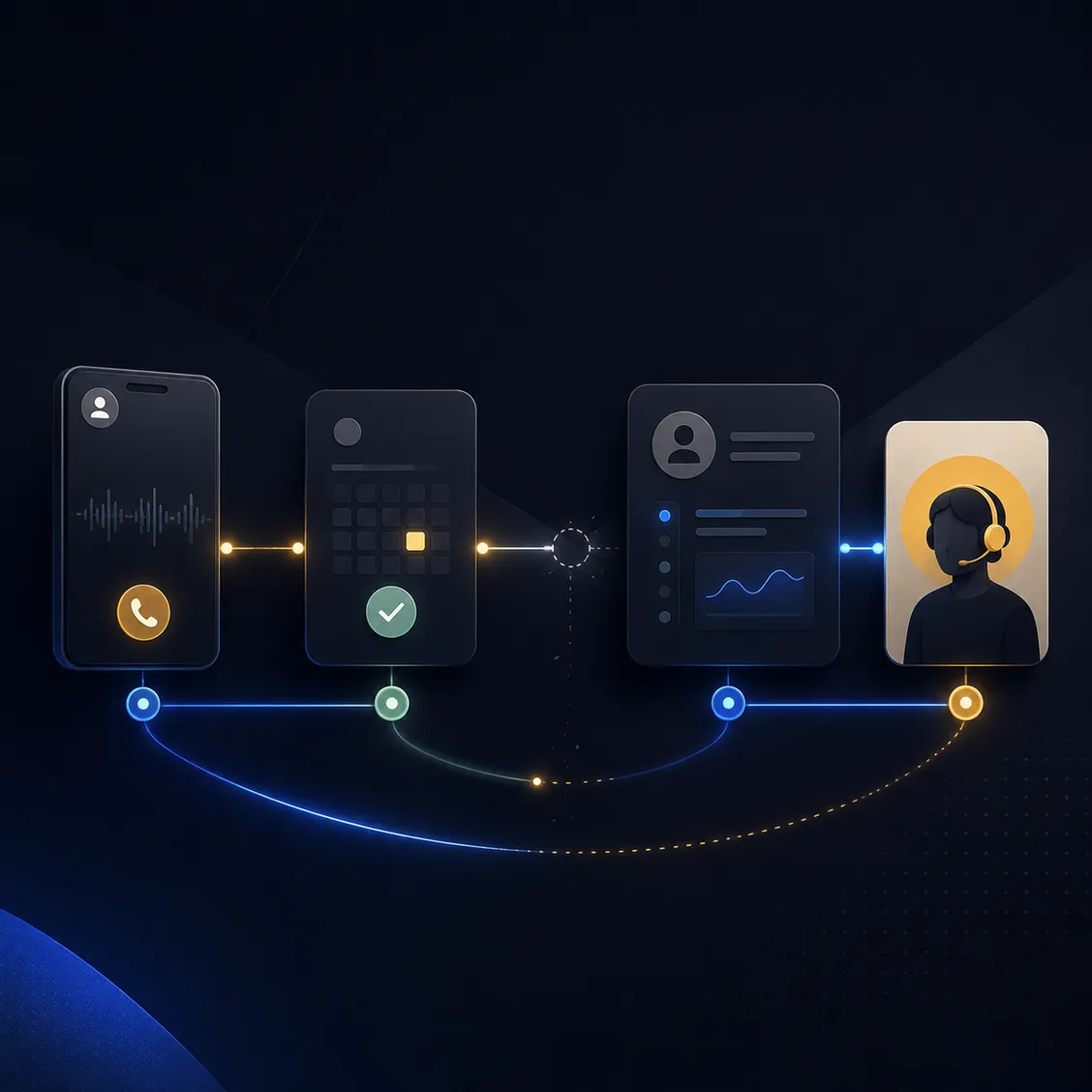
When the phone, calendar, CRM, inbox, and team all know what happened, the lead journey becomes much harder to break.
Human handoffs need context
Automation cannot and should not handle every situation.
Some conversations require judgment, empathy, negotiation, or expertise.
But when a human steps in, they should not need to reconstruct the story.
A good handoff should provide:
- Who the lead is
- What they need
- What they have already said
- What the system has already done
- Why the lead is being escalated
- What the human should do next
That makes the human response faster and more relevant.
The person can continue the conversation instead of restarting it.
This is especially important in legal, healthcare, home services, consulting, and other high-trust businesses where repeating sensitive or detailed information creates friction.
Exceptions reveal whether the system actually works
Most workflows are designed around the ideal path:
The lead responds. They qualify. They book. They attend.
Real life creates exceptions.
The prospect provides incomplete information.
They ask a question the system cannot answer.
They book the wrong service.
They cancel.
They do not attend.
They reply to an old message weeks later.
They contact the business through two different channels.
A strong system is not defined only by what happens when everything goes right.
It is defined by what happens when the process becomes messy.
The workflow should know when to pause, reroute, alert someone, merge information, or ask for human help.
That is where reliable implementation differs from a simple automation demo.
Map the handoffs before adding more tools
Before buying another CRM, chatbot, phone system, or automation platform, map the current lead journey.
Start with one recent inquiry and trace it from beginning to end.
Ask:
Where did it enter?
Who responded?
What information was captured?
Where was that information stored?
Who owned the next action?
Was the appointment booked?
Did the CRM update?
Was follow-up scheduled?
What happened when the lead stopped responding?
This exercise often reveals that the business does not have one lead process.
It has several disconnected processes held together by people remembering what to do.
The answer may not be another tool.
It may be a better connection between the tools already in use.
The handoff is not a small detail
Businesses often focus on the visible parts of the customer journey:
The advertisement.
The website.
The phone call.
The appointment.
The sale.
But opportunities are frequently lost in the invisible spaces between those moments.
The note that was never entered.
The task that was never assigned.
The appointment that was never confirmed.
The message that nobody followed up.
The manager who never received the alert.
Those gaps may seem operational.
But they directly affect revenue.
Because the lead does not experience your departments, tools, and internal responsibilities separately.
They experience one business.
When the handoffs fail, the entire business feels slow, forgetful, or difficult to work with.
The takeaway
A lead process is only as strong as the moments where responsibility, context, and action move from one place to another.
Capturing the inquiry is not enough.
The phone, calendar, CRM, automation, and person expected to act must operate as one connected flow.
Because the handoff is not merely part of the system.
The handoff is the system.