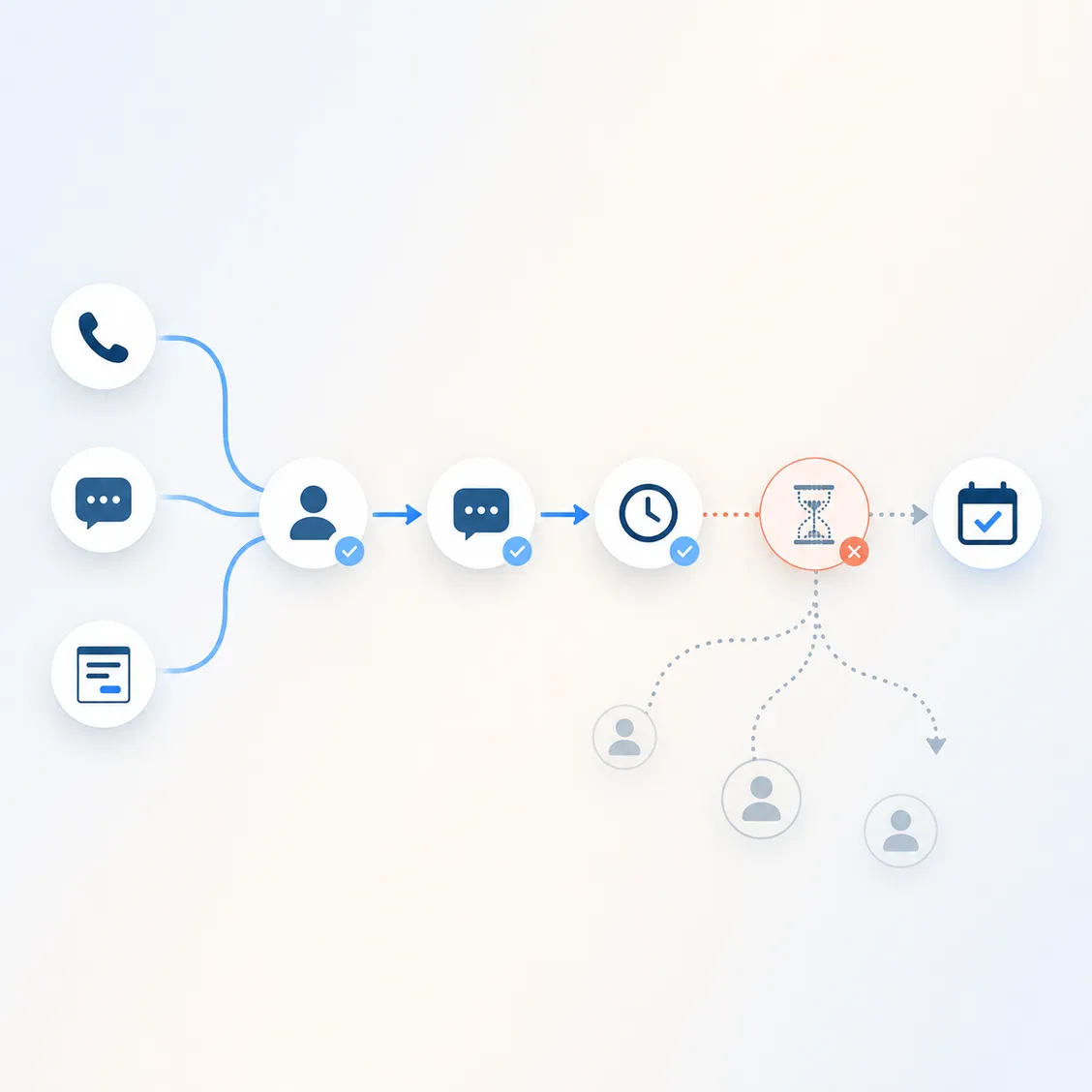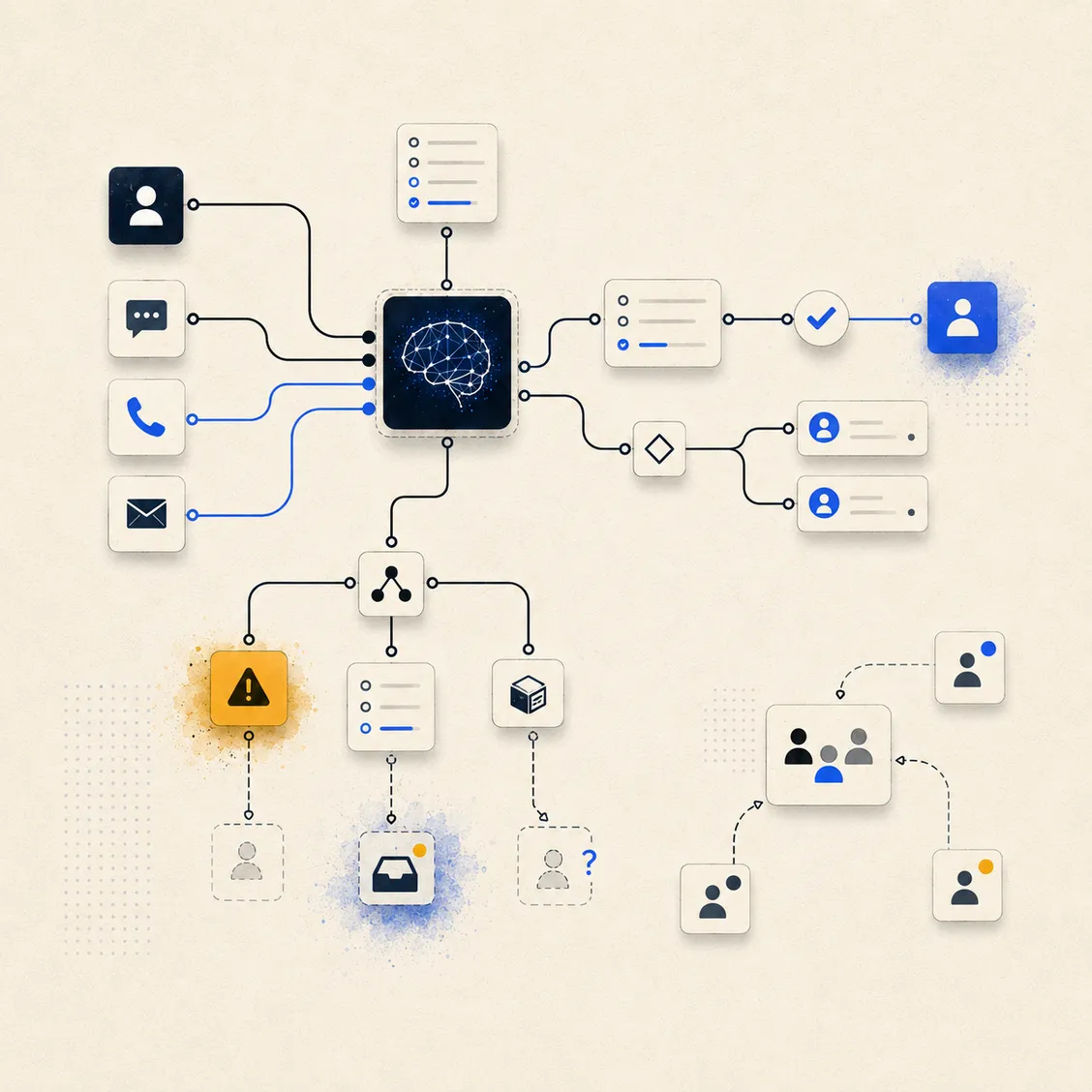


What AI should handle, when humans should take over, and how the handoff should work.
AI is excellent at handling repetition.
It can answer the same question for the hundredth time without losing patience.
It can collect information, check availability, send reminders, update records, and follow a process at two in the morning as reliably as it does at two in the afternoon.
That makes it valuable.
It does not make it suitable for every conversation.
The mistake is not using AI.
The mistake is asking it to handle moments that require judgment, empathy, accountability, or a real human decision.
A useful AI system should know what it is responsible for.
A trustworthy one should also know when to stop.
The goal is not to remove humans
Many automation projects begin with the wrong question:
How much of this can AI replace?
A better question is:
Which parts of this process should no longer depend on a human being available at the exact right moment?
Those are very different goals.
The first treats people as an expense to eliminate.
The second protects people from repetitive work while keeping them involved where their presence creates value.
AI should handle the predictable parts:
- Responding immediately
- Answering approved questions
- Collecting routine information
- Qualifying against clear criteria
- Checking calendars
- Booking appointments
- Sending reminders
- Updating systems
- Triggering follow-up
- Routing the conversation
Humans should handle the parts that require:
- Judgment
- Empathy
- Negotiation
- Exceptions
- Sensitive information
- Professional advice
- Accountability
- A decision the system is not authorized to make
Good automation does not erase that boundary.
It makes the boundary explicit.
AI should handle the repeatable work
The strongest use cases for AI usually have three things in common.
The task happens often.
The rules are reasonably clear.
The cost of waiting is higher than the value of having a human perform every step manually.
Consider a dental practice.
An AI receptionist can answer whether the clinic is open, ask what type of appointment the caller needs, check availability, and book a suitable time.
It does not need to interrupt the front desk for every routine call.
But if the caller describes severe pain, swelling, trauma, or a complicated medical concern, the system should not continue treating the conversation like a standard booking.
The situation has changed.
The right action may be to escalate, advise the caller to seek urgent care according to approved clinic guidance, or connect them with a qualified staff member.
The AI did not fail by stopping.
Stopping was part of doing the job correctly.
Clear rules create useful AI
AI performs best when the business has already decided how common situations should be handled.
For example:
- Which services can be booked automatically?
- Which inquiries should be disqualified?
- What information must be collected first?
- Which questions have approved answers?
- When should a call be transferred?
- What counts as urgent?
- Which cases require manager approval?
- When should the system stop messaging?
Without those rules, the AI is forced to improvise.
That is where risk increases.
The system may sound confident while giving an answer the business never approved.
It may continue a conversation that should have been escalated.
It may book the wrong appointment type.
It may make a promise the team cannot keep.
The technology is not always the main problem.
Often, the underlying process was never clearly defined.
AI exposes that ambiguity because it cannot safely rely on office intuition, unspoken habits, or what one experienced employee “just knows.”
Before automating a workflow, the business has to make those hidden rules visible.
Confidence should never be mistaken for certainty
AI can sound certain even when it is wrong.
That matters because customers often interpret a clear answer as an authorized answer.
If an AI agent states that a service is covered, a claim is likely to succeed, a treatment is appropriate, or a refund will be approved, the customer may act on that information.
The system should therefore avoid making decisions outside its authority.
A safer design uses boundaries such as:
- “I can help collect the details and arrange the next step.”
- “A member of the team will need to confirm that.”
- “I do not want to give you the wrong answer, so I’ll pass this to someone who can verify it.”
- “This sounds like something a qualified person should review.”
That language does not make the system look weak.
It makes it look responsible.
Customers do not expect every receptionist to know everything.
They expect the receptionist to know who should take over.
An AI agent should work the same way.
Emotion changes the conversation
A routine interaction can become sensitive very quickly.
A caller may begin by asking about availability, then reveal that they are frightened, angry, grieving, embarrassed, or under pressure.
At that point, speed and efficiency are no longer the only priorities.
The person may need reassurance.
They may need someone to listen.
They may need an answer that cannot be reduced to a scripted decision tree.
This is especially important in fields such as:
- Healthcare
- Personal injury law
- Family services
- Financial hardship
- Complaints
- Emergency repairs
- High-value sales
- Sensitive customer support
The AI can still help.
It can recognize escalation signals, collect essential context, avoid making the person repeat themselves, and alert the right team member.
But it should not try to imitate empathy indefinitely while blocking access to a human.
There is a difference between acknowledging emotion and handling it.
AI can often do the first.
A person may be needed for the second.
Exceptions belong with people
Automations are built around expected paths.
Real businesses are full of exceptions.
A customer wants a service outside the normal area.
An existing client has a special agreement.
A booking needs to be moved into a protected time slot.
A lead almost qualifies but has an unusual situation.
A payment failed for a reason the system cannot verify.
A caller asks for something technically against policy, but the manager may choose to approve it.
These situations require context and authority.
The AI should not invent a solution merely to keep the conversation moving.
It should recognize that the request falls outside the normal rules and create a clean handoff.
That might mean:
- Alerting a manager
- Creating a high-priority task
- Transferring the call
- Collecting the details and promising a confirmed response
- Pausing the automated sequence
- Assigning ownership in the CRM
The handoff should make the exception easier for the human to resolve.
It should not dump an unexplained problem into another inbox.
A handoff should carry the conversation forward
Poor handoffs make customers start again.
They explain the issue to the AI.
Then they explain it to reception.
Then they explain it to sales.
Then they explain it again to the person actually responsible.
By the time they reach the right human, the system has created more friction than it removed.
A good handoff carries the context with it.
The person taking over should receive:
- The customer’s name and contact information
- The reason for the inquiry
- The important questions already asked
- The answers already provided
- The customer’s preferred next step
- Any urgency or emotional signals
- The point where the AI stopped
- The action required from the human
The customer should not need to reconstruct the conversation.
The human should be able to enter with something like:
“I can see you were asking about moving your appointment and that the usual times do not work. Let me help with the exception.”
That feels coordinated.
It shows the customer that they were heard.
The customer should know what is happening
One of the worst handoff experiences is silent escalation.
The AI says it will “pass this to the team,” but gives no indication of what that means.
Will someone call?
Will they email?
How long will it take?
Should the customer wait?
Should they contact the business again?
A good handoff explains the next step clearly.
For example:
“This needs a member of our team to review. I’ve sent them the details, and someone will call you within one business hour.”
Or:
“I can transfer you now. If the line is busy, the team will receive your conversation summary and call you back.”
Or:
“I’ve paused the booking here because the appointment type needs confirmation. You do not need to repeat the details—we’ve saved them for the team.”
The promise should match what the workflow can actually deliver.
A precise handoff builds trust.
A vague one creates another waiting problem.
Humans need a clear reason to step in
Internal alerts often fail because they contain too little information.
A notification says:
New lead needs assistance.
That creates work before the employee can even decide what to do.
A useful alert should explain:
- Who needs help
- What happened
- Why the AI escalated
- How urgent it is
- What the human needs to do next
For example:
High-priority call: existing patient reports severe swelling after treatment. AI stopped routine booking and requested clinical review. Call back within 10 minutes.
Or:
Qualified personal injury inquiry. Incident occurred within the accepted timeframe, but the caller has an unusual employment status. Attorney review required before consultation booking.
The purpose of automation is not merely to move information.
It is to make the next action obvious.
The handoff needs ownership
A system can escalate correctly and still fail if nobody owns the next step.
Sending a notification to a general Slack channel does not guarantee action.
Adding a note to the CRM does not guarantee someone will see it.
Forwarding an email does not establish responsibility.
Every handoff should answer:
Who is now responsible?
That may be determined by:
- Location
- Service type
- Lead value
- Urgency
- Team availability
- Existing account ownership
- Language
- Professional expertise
The assigned person should receive the task directly.
The system should also know what happens if they do not act.
Should it notify a manager?
Reassign the lead?
Send another alert?
Update the customer?
A handoff is not complete when the message is sent.
It is complete when responsibility has moved and the next action is underway.
Automation should pause when a human takes over
Another common failure happens when the AI and the employee continue talking at the same time.
The customer receives a personal reply from a staff member.
Then an automated message arrives five minutes later asking the same question.
The employee schedules the appointment.
Then the system sends another booking link.
The customer says they are not interested.
Then the follow-up sequence continues for another week.
This makes the business look disconnected.
Once a human takes ownership, the automation should know whether to:
- Pause completely
- Move into support mode
- Continue only with approved reminders
- Wait for the human to release the conversation
- Resume after a specific period
The workflow needs one source of truth.
If the CRM says a person has taken over, the AI should not continue acting as though nothing changed.
Not every business needs the same boundary
There is no universal line where AI should stop.
A simple service business may allow an AI agent to book most appointments independently.
A law firm may require human review before accepting a consultation.
A clinic may automate administrative questions but restrict anything that sounds clinical.
A home services company may allow automated estimate booking but escalate safety concerns or complex commercial work.
The right boundary depends on:
- Risk
- Regulation
- Value of the transaction
- Complexity
- Customer sensitivity
- Business policy
- The authority given to the system
- The consequences of being wrong
That boundary should be designed deliberately.
It should not emerge accidentally after the system makes a mistake.
Start with low-risk, high-volume work
A practical implementation does not begin with the most complicated conversation in the business.
It begins where the rules are clear and the volume is high.
That may include:
- Answering routine calls
- Capturing new inquiries
- Checking basic fit
- Booking standard appointments
- Sending reminders
- Following up after no response
- Updating the CRM
- Routing requests
- Notifying the team
Once those workflows are reliable, the business can expand carefully.
Each new capability should answer:
- Is the system authorized to do this?
- Does it have enough information?
- What could go wrong?
- How will it recognize uncertainty?
- Who takes over?
- What context will they receive?
- What stops the automation afterward?
The goal is not to make the AI capable of everything.
It is to make it dependable at the things it is trusted to do.
Good automation makes humans more available
When AI handles repetitive questions, routine qualification, booking, reminders, and administrative updates, the team has more time for the conversations that actually need them.
A receptionist can focus on the anxious caller instead of repeatedly confirming opening hours.
A sales rep can speak with a qualified prospect instead of chasing incomplete forms.
A manager can resolve an exception instead of manually assigning every lead.
A practitioner can enter the conversation after the relevant information has already been collected.
That is the strongest argument for AI.
Not that humans disappear.
That humans become more available where their attention matters most.
The best system knows its limits
A useful AI agent should be fast, consistent, informed, and available.
It should also be comfortable saying:
This needs a person.
That is not a weakness in the design.
It is evidence that the design understands the business.
The strongest systems automate the ordinary, detect the unusual, preserve the context, and bring in a human before trust is damaged.
AI should not keep going simply because it can generate another response.
It should keep going while the situation remains within its role.
And when it no longer does, the handoff should feel like one continuous conversation—not the point where the customer falls through another gap.
The takeaway
AI should handle the work that is frequent, structured, and safe to standardize.
Humans should take over when the conversation requires judgment, empathy, authority, or an exception the system is not allowed to resolve.
The quality of the system depends on the space between those two.
Define the boundary.
Detect the moment.
Carry the context.
Assign the right person.
Pause the automation.
That is how AI becomes part of the team without pretending to be the whole team.